
July 21, 2026
Cities That Grow Housing Supply Get Paid
A new federal Innovation Fund would pay local governments, but only after they prove housing supply has grown.
Author: Ivory Innovations Student Associate Daniel Rhondeau
Housing affordability has been the defining domestic policy challenge of the past decade, and for most of that decade the federal response rewarded process over production. Local governments received funding to study barriers, expand staff capacity, and produce plans, while the outcome that matters most, the number of homes actually built, frequently went unmeasured. The recently passed 21st Century ROAD to Housing Act begins to change that calculation.
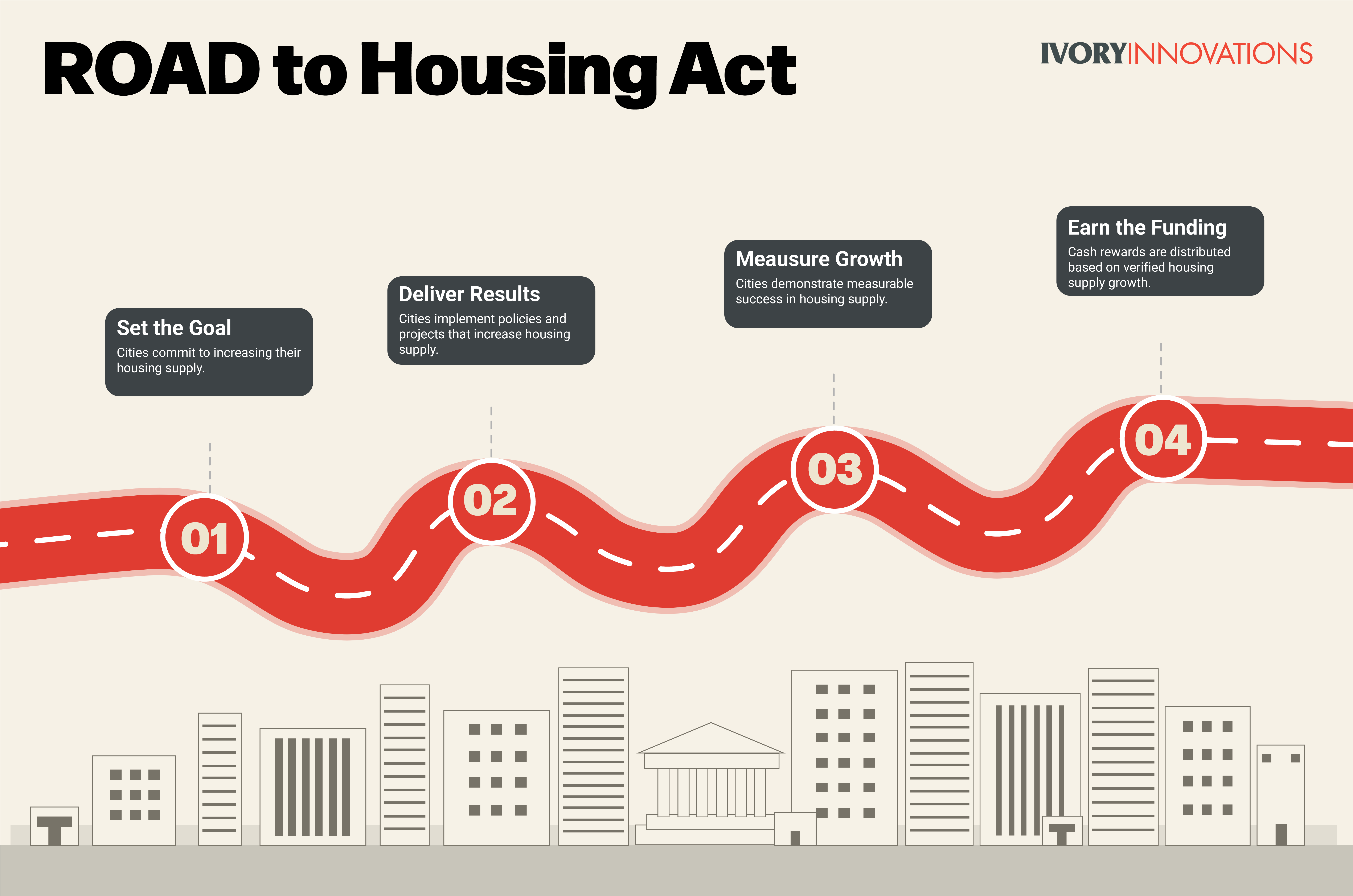
Within the act is a new Innovation Fund, authorized at $200 million per year for seven years. Its design marks a clear departure from how federal housing dollars have typically been distributed. The fund pays local governments and tribes only after they demonstrate measurable growth in housing supply, with priority given to jurisdictions that adopt the Department of Housing and Urban Development's (HUD) new Housing Supply Frameworks. In short, the money follows production rather than intention.
The measure also reflects a rare degree of consensus. The act passed the U.S. Senate 85 to five and the U.S. House 358 to 32, bipartisan margins seldom seen, but that show the urgency of housing legislation. At Ivory Innovations, we have spent years supporting the cities and practitioners pursuing exactly this kind of supply-focused reform, and the fund codifies that outlook into federal policy.
WHY SUPPLY IS THE PRIORITY
The fund's emphasis on supply reflects our thesis around the affordability issue: the cost of housing is, at its foundation, a function of how much of it exists. We at Ivory Innovations are focused on innovations in the public, private, and nonprofit sectors who drive supply forward. When a jurisdiction makes building faster, less expensive, and more predictable, the benefits extend well beyond the individual project. Rents stabilize, neighborhoods strengthen, and households that would otherwise be priced out are able to remain. Supply is not one policy lever among many. It is the precondition that determines whether the others, from rental assistance to tenant protections, can succeed.
WHAT THE INNOVATION FUND REWARDS
What distinguishes the Innovation Fund is its conditionality. Rather than funding effort, it actually funds the results. A jurisdiction qualifies by documenting growth in housing supply, and it advances in priority by adopting HUD's Housing Supply Frameworks rather than by the strength of its application narrative. The distinction is consequential. Federal housing programs have historically financed plans, studies, and administrative capacity, important inputs that nonetheless stop short of production. By tying dollars to homes delivered, the fund shifts the advantage toward jurisdictions that already treat permitting and construction as core municipal functions rather than procedural hurdles.
HOW A CITY CAN POSITION TO COLLECT
Cities have considerable latitude in how they pursue the fund, and many of the most effective steps require little or no direct expenditure. Regulatory reform is the most accessible starting point. By-right approvals, the legalization of accessory dwelling units (ADUs), and the elimination of parking minimums all expand what can be built without committing public funds, and they generate the permitting and completion data the fund will use as evidence of progress.
Beyond reform, the fund can address the less visible constraints on housing production. Water and sewer grants can unlock infill parcels that are otherwise infeasible, and predevelopment financing can cover the early-stage costs that often deter smaller builders. Structured as a revolving fund, each repayment can be redeployed into subsequent projects, extending the reach of a single appropriation.
The fund can also be used to reshape the economics of construction itself. Aggregating demand across jurisdictions gives modular and offsite manufacturers the order volume necessary to price competitively. ADU toolkits, the adaptive reuse of vacant commercial buildings, and development on publicly owned land each offer additional pathways to new supply. Finally, jurisdictions that apply regionally, or that layer the Innovation Fund alongside existing HOME Investment Partnerships and Community Development Block Grant (CDBG) resources, can present greater scale and stretch each federal dollar further.
CITIES ALREADY DEMONSTRATING THE MODEL
The approach the fund rewards is not hypothetical. Through the Ivory Prize for Housing Affordability, Ivory Innovations has spent years identifying jurisdictions that have implemented these strategies and produced measurable results. Three honorees illustrate what supply-focused reform looks like in practice.
New Rochelle, New York treated its permitting process as housing infrastructure. A Downtown Overlay Zone, form-based codes, and a streamlined 90-day by-right approval path helped produce approximately 4,500 homes since 2020, without direct subsidy. (2026 Ivory Prize Winner, Policy & Regulatory Reform.)
Montgomery County, Maryland demonstrates the revolving-fund model. Its Housing Production Fund provides low-cost construction loans to publicly owned, mixed-income developments. Because each project repays within roughly five years, the approximately $100 million fund continually recapitalizes itself, with at least 30% of homes remaining permanently affordable. (2024 Ivory Prize Winner, Finance.)
Chattanooga, Tennessee redesigned its tax incentive to align directly with the cost of producing affordable housing. A restructured payment-in-lieu-of-taxes (PILOT) program ties each abatement to the actual cost of an affordable unit, supported by a public calculator that makes the trade transparent to every applicant, inducing mixed-income production without a direct outlay. (2026 Ivory Prize Winner, Policy & Regulatory Reform.)
WHAT COMES NEXT
Because the fund is designed to reward supply growth that is already underway, the jurisdictions that begin their next cycle of reform now will be best positioned when funding becomes available. Ivory Innovations will continue to identify and support the practitioners and cities demonstrating what works, and stands ready to assist those seeking to translate the Innovation Fund into housing.