December 12, 2025
The Cost of Time in Development: Lessons from The Little Book
This resource showcases practical tools, proven strategies, and inspiring success stories reshaping housing policy and delivery.
Author: Ivory Innovations Vice President of Policy & Partnerships Amy Tomasso
At Ivory Innovations, we believe the future of housing in America is bright: not because the challenges have disappeared, but because the solutions have never been more promising. Across the country, innovators, policymakers, builders, and community leaders are demonstrating that we can deliver more homes, more affordably, and more efficiently than the status quo. Our newest resource, The Little Book of Low-Cost, High-Impact Housing Solutions, captures and shares this momentum. Rather than dwelling on scarcity or constraints, it showcases the practical tools, proven strategies, and inspiring success stories that are already reshaping what’s possible in housing policy and delivery.
For us, The Little Book is more than a guide. It’s validation of the energy, creativity, and collaborative spirit we see every day through the Ivory Prize, our Fieldworks partnerships, and our broader work accelerating housing innovation. It affirms that when communities rethink outdated processes, embrace new construction methods, and lean into smart policy design, they can unlock meaningful, scalable, and rapid improvements in housing affordability.
Six Key Levers to Unlock More Housing, More Quickly
At the heart of The Little Book are six core strategies cities and builders can deploy today.
Streamline Approval Processes
- What It Means: Fast-track reviews, use permitting software, allow third-party plan reviewers or pre-approved plans.
- Why It Matters: Permitting delays are one of the single biggest causes of cost inflation. Reducing “time-to-build” also reduces financing and carrying costs, shaving thousands of dollars off final unit prices.
Simplify Design Standards
- What It Means: Use pre-approved architectural plans, reduce or standardize parking minimums, eliminate overly restrictive garage and other stylistic requirements.
- Why It Matters: Overly rigid design codes, often rooted in arbitrary aesthetic preferences, can add cost without adding value to residents. Simpler design standards unlock more housing starts, more quickly.
Build Infill on Existing Infrastructure
- What It Means: Encourage development on underused parcels within existing service areas (roads, utilities, transit), rather than sprawling outward.
- Why It Matters: Infill leverages existing investments in infrastructure, making new development cheaper, more sustainable, and closer to jobs and transit.
Plan for Smart Density / Zoning Reform
- What It Means: Enable a variety of housing typologies (duplexes, triplexes, courtyard apartments, “missing-middle” housing) rather than only single-family or large-scale apartments.
- Why It Matters: Zoning reform unlocks gentle density: enough to ease supply pressure and create opportunities for affordable middle-income housing, without radically changing neighborhood character.
Partner on Housing Solutions (such as Public-Private Collaborations & Innovative Financing)
- What It Means: Use creative financing, subsidy layering, public-private partnerships or community land trusts to further reduce barriers to construction and affordability, and broaden support for increasing housing supply.
- Why It Matters: Traditional financing and funding models can constrain new housing types, like missing middle homes, as well as stymy more inclusive ownership structures– and more affordable units. Leveraging partnerships expands tools and possibilities for builders and communities alike.
Employ New Construction Methods
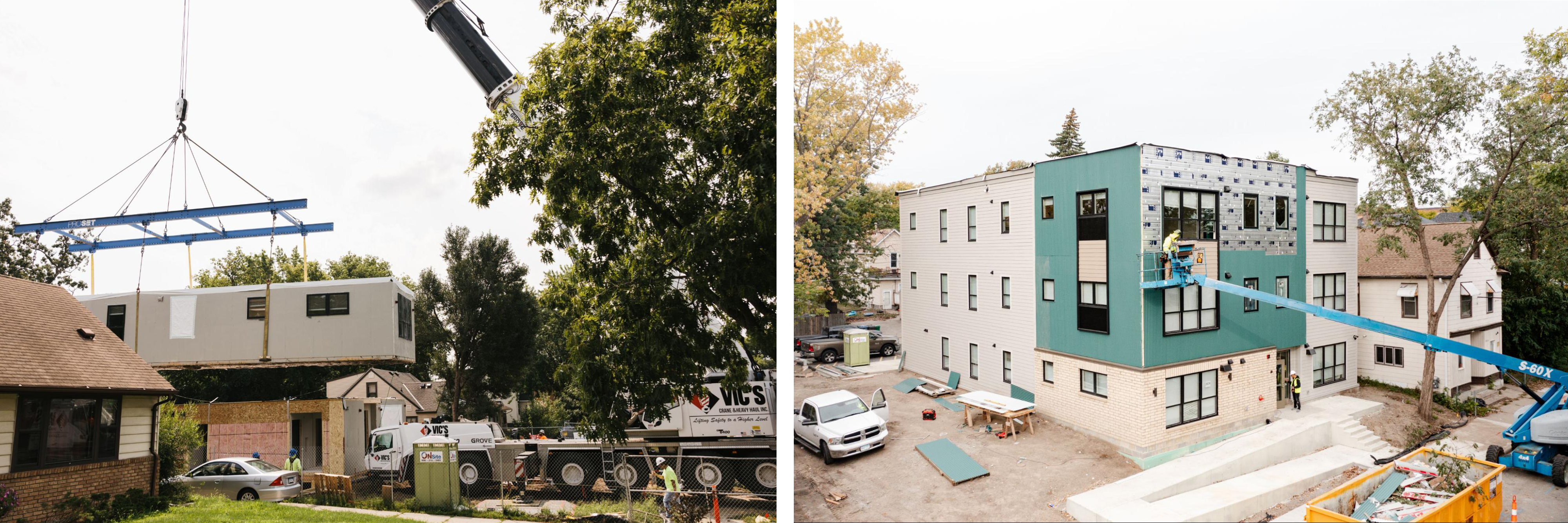
- What It Means: Embrace modular, manufactured, or factory-built housing technologies and offsite-produced components.
- Why It Matters: These methods can reduce labor costs, shorten timelines, and improve quality, helping to scale affordable housing faster than traditional stick-built approaches.
The Little Book features each of these policy levers accompanied by concrete checklists, municipal-level action items, and case studies from six pioneering cities.
Cities Doing It Right: Real-World Case Studies
One of the most powerful parts of The Little Book is its grounding in actual municipal policy shifts that are already producing new units, more quickly. For example, Austin, TX, streamlined approvals for small-scale projects that have cut months and thousands of dollars from development timelines. And South Bend, IN, championed simplified design standards through pre-approved plan sets.
By showing examples of cities across the country already deploying these strategies, The Little Book undermines arguments that “nothing else will work” or that “new housing will destroy neighborhood character.” Here’s what we’ve learned from surveying the most promising policy actions:
- In many cases, innovators started with modest changes—a new “pre-approved plan library,” reduced parking minimums, or fast-track permitting—that significantly cut development timelines, instead of overhauling the whole process.
- In others, they embraced novel housing typologies, enabling missing-middle housing in neighborhoods previously restricted to single-family homes. This seemingly little change is crucial to unlocking new housing supply, especially when supported by other regulatory reforms such as simplifying small-scale building codes and reducing large lot sizes.
- Some innovators integrated modular or factory-built units into affordable or workforce housing projects, demonstrating that cost-effective construction at scale is feasible without sacrificing quality or resident dignity.

The takeaway: bold ambitions are helpful, but incremental, actionable changes can prove out sound policy that delivers real, measurable housing outcomes.
Focusing on Solutions
The Little Book reframes the housing crisis not as a problem of resources, but as a problem of process. Too often, the bottlenecks, including zoning restrictions, drawn-out approval processes, and labor-intensive construction practices, add unnecessary cost and time–which can kill projects before they get off the ground.
For local governments, nonprofit developers, and private builders, The Little Book offers a shared playbook and a toolbox of proven strategies. Even more importantly, it proves that real policy progress is happening now, and shows cities and towns everywhere how to implement solutions, too.